 Notare
Your meetings, transcribed and enhanced — locally.
A local-first meeting notetaker and dictation app that saves plain Markdown directly into your Obsidian vault. Powered by on-device engines (Whisper, Parakeet, Voxtral including Hindi support) with self-hosted GPU node transcription. Open source, MIT licensed, and completely tracker-free.
How it works
A precision instrument, not another AI subscription.
No meeting bots joining your calls. No audio leaving your machine. Notare listens where you are, and everything it produces is a file on your disk.
01 Live transcription & dictation
Capture every word in real-time or dictate notes using the elegant, themeable interaction orb. Notare transcribes with zero delay using optimized local Whisper models, transforming spoken dialogue into structured text as you speak.
02 Notepad-first enhancement
You take rough notes during the meeting, like you always have. Afterwards, Notare enhances your notes — filling gaps, fixing names, attaching decisions — using the transcript as context. It sharpens what you wrote; it doesn't replace you with a summary bot.
orders_v2 flag;
1-week error-budget watch. Rollback =
flag off. Owner: Priya, by Fri.03 Plain Markdown, straight into your vault
Every note and transcript is a plain .md file saved
to any folder you choose — including your Obsidian vault. No
proprietary database, no export button, no lock-in. If Notare
disappeared tomorrow, your notes wouldn't notice.
04 On-device engines per platform
Notare runs highly optimized speech models locally. Point to Whisper, Parakeet, or Voxtral (including high-accuracy Hindi models) tailored for your operating system's GPU framework. No telemetry, no API fees, and absolute privacy.
- STT
- whisper-small-q8 · local ✓ verified
- LLM
- ollama · http://localhost:11434 ✓
- Calendar
- Google · your OAuth client ✓
- Telemetry
- not compiled in
Self-hosted power
Your GPU box does the heavy lifting.
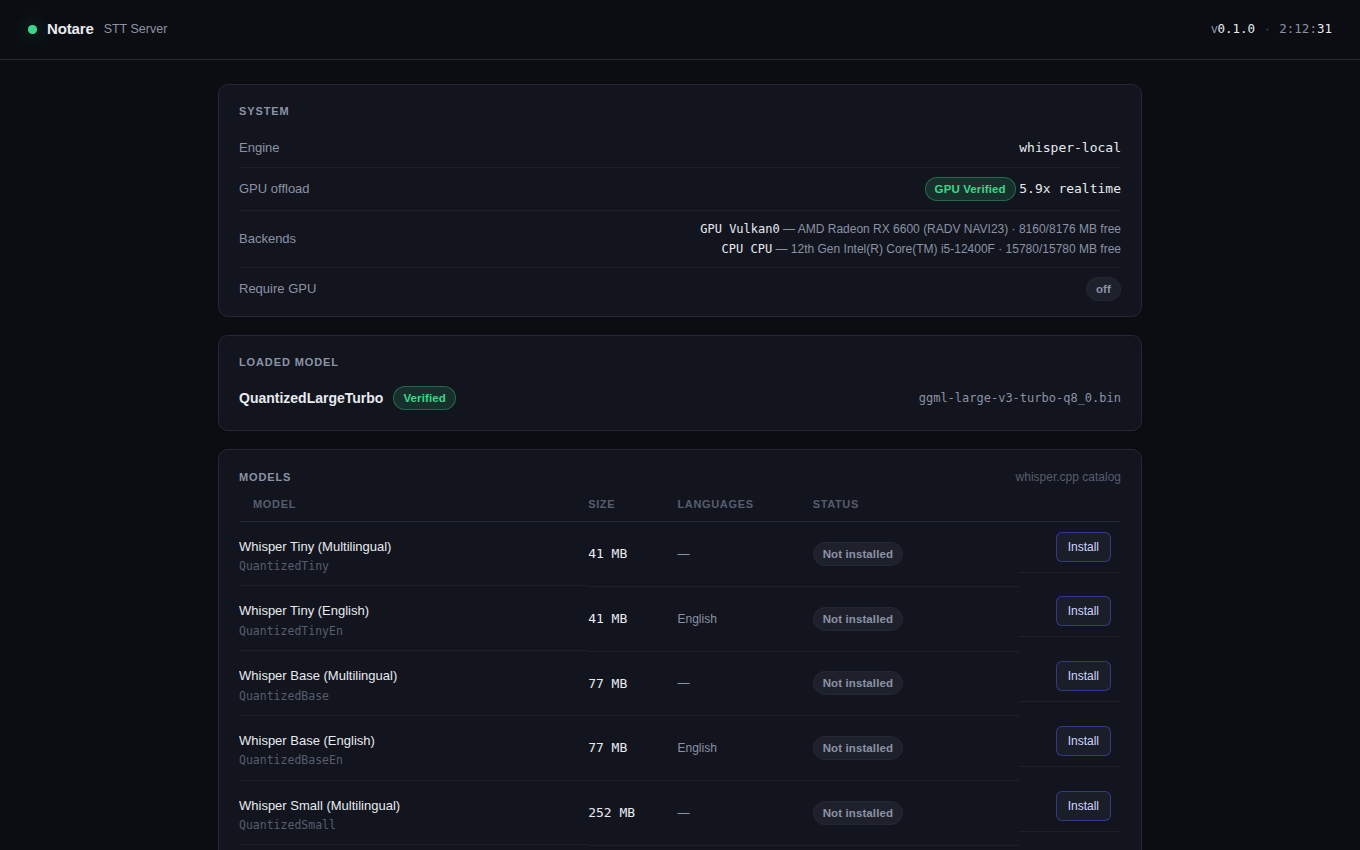
Notare v0.3 introduces a self-hosted transcription server. Run the heavy models on a separate LAN machine with a GPU so your laptop battery stays cool and your workspace remains silent.
Blazing fast LAN transcription
Deploy Notare's pre-configured Docker images with support for CPU, Vulkan, and NVIDIA CUDA. Point Notare at your server's address — one URL, and every transcription runs on your own GPU.
- Unified Docker build: Fast setup for any GPU-equipped Linux/Windows host.
- Zero configuration: Point client to the server's IP address and transcribe.
- Extremely efficient: Verified performance reaching 5.9x realtime speeds.
Visual tour
See it in action.
Notare provides a clutter-free, responsive environment optimized for quick note-taking, transcript auditing, and distraction-free dictation.
The covenant
Free means free. In writing.
Everything that works locally is free. Forever. No feature you have today will ever move behind a paywall. Notare+ will sell convenience — hosted sync and models — never capability.
— The Notare covenant. It's in the repo, under version control, like everything else. See exactly what Notare+ will charge for →
Download
Get Notare
Every link below always serves the newest release — no version numbers to chase. Grab it once; updates land in the same place.
Windows
.msi installerStandard signed MSI installer for Windows 10/11. Simple, secure installation experience running warning-free. Every release package is cryptographically signed and verifiable against the open-source codebase. Download .msi — latest release
Linux
.AppImage / .deb
Portable AppImage (any distro — chmod +x and run) or a
.deb package for Debian and Ubuntu. Local Whisper transcription with
Vulkan and CUDA acceleration works out of the box.
Download .AppImage / .deb — latest release
macOS
.dmg · Apple SiliconFully notarized disk image for Apple Silicon Macs (M1 and later), with Metal-accelerated transcription. Signed and notarized to pass Apple Gatekeeper checks out of the box. Download .dmg — latest release